
Ergonomic considerations for wheelchair users and the disabled
We are all physically disabled at some time in our lives. A child, a person with a broken leg, a parent with a stroller, an elderly person, or a foreigner speaking an unfamiliar language are all hindered in one way or the another. Hence, integrating the needs of the disabled with the needs of the able-bodied accounts for the needs of the majority of individuals.
Initially the issue of integrating facilities for the various kinds of disabilities was considered. Considerations for the visually impaired included providing labels, brochures & maps with Braille & relief, consistent layout and heights of labels, information & relief, cassette guides, highlighted textures/colors on floor paths, tactile discovery, bright colors and bigger texts & signages etc. Plastic resin material is resistant, has a range of colors & and a high reliability of relief. Some services provided by specialty firms could prove useful. Minitel transforms what appears on computer into electronic voices, and ‘HORIZONS FOR THE BLIND’ adapts services for the blind & partially sighted.
Considerations for the audibility impaired included making text language sound like simple declarative sentences, providing sound reinforcement in the form of magnetic induction, high frequency communication & infrared systems, etc.
The general recommendations for wheelchair users include providing adjustable viewing heights, viewing accessibility areas, comfortable display heights (at lower eye level), and adjustable viewing angles.

Adjustable viewing heights
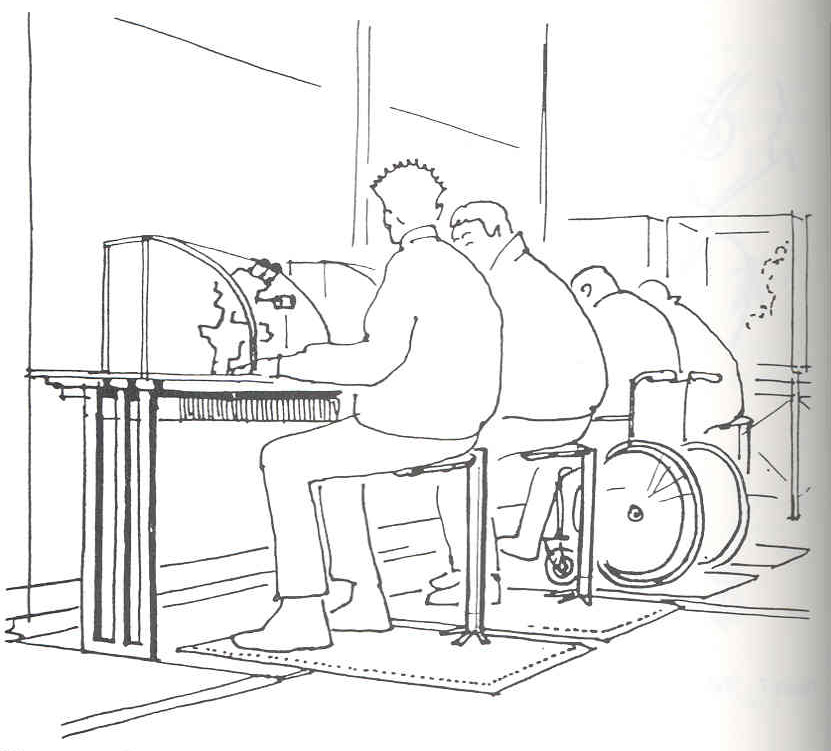
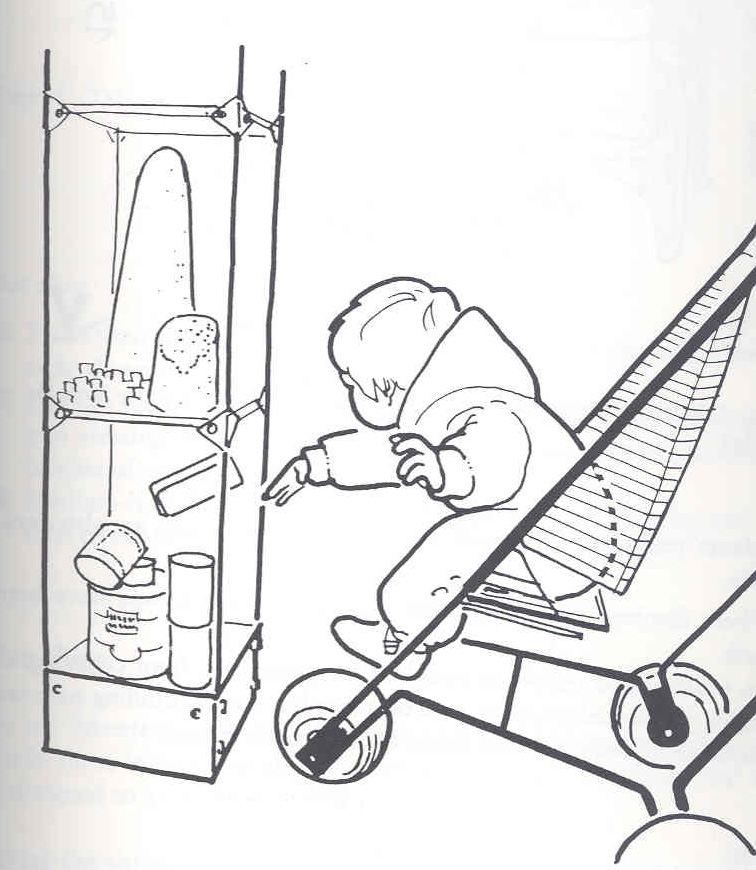
Accessibility and Display heights/viewing
In the later part of the project, the scope of the study was focused on the issues of wheelchair users accessing the fossil pit. The main points to consider for the design were issues of height and reach while on the wheelchair, leg room while accessing, front and side hand reach distances, and the free space required to maneuver around the pit area. It was felt that the reach heights common to the able-bodied and wheelchair users be utilized, this design also provides for the height reach distances for younger children, whose height is on the order of that of wheelchair users.

The common reaching zone is found to be between 3-4 2/3 ft.‘

Another thing to consider is the forward reach distance for picking up the fossil. But since the new design had ample legroom for it, it was not a major limitation; we recommend a reach of 3-4 ft.
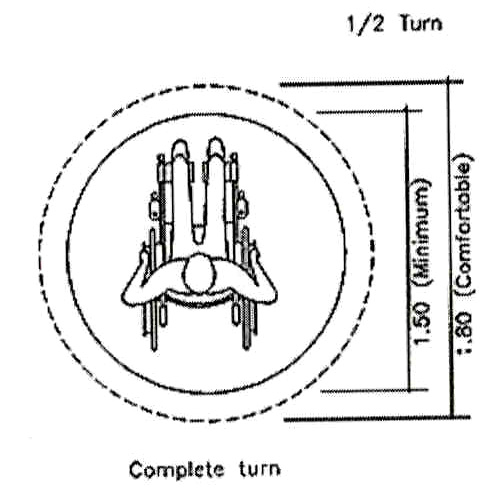
A distance of 5-6 ft is recommended around the pit for the free turn of the wheelchair.